

UFO – part 1
By Brian Poulsen | April 2026
Introduction: Establishing the understanding

When the Vikings, or rather the Norsemen, sailed from the Scandinavian coasts via Iceland and Greenland towards the North American continent (Vinland) around the year 1000, these were journeys that took place in long stages and not one long continuous crossing. Theoretically, the ships themselves (“knarr” – cargo ships) were probably strong enough to have managed a direct trip across the Atlantic, but in practice, it would have been pure suicide, and there is no evidence that it was ever attempted at that time. The distance from the coast of Norway directly to Newfoundland is over 4,200 kilometers (approx. 2,610 miles). And their total travel time from Scandinavia via Iceland and Greenland to North America must therefore be counted in seasons with many long stops along the way, which makes the distance even longer.
The Norsemen who had established themselves permanently in Greenland (including Leif Erikson and his father Erik the Red and their descendants) continued to sail to present-day Labrador in Canada for several hundred years after the year 1000 to fetch timber and supplies. But here we are not talking about crossing the Atlantic Ocean, but rather what is called the Labrador Sea and, a little further north, the Davis Strait. This was also a journey divided into stages. First a few days from Greenland to Baffin Island (which they called Helluland – “the land of flat stones”), after which they sailed a few more days south along the coast to reach Labrador (Markland – “the land of forests”). Here we are talking about a confined voyage across a relatively narrow stretch of sea, which could be completed in just under a week.
Just under 500 years later, ships in Europe had generally undergone a technological evolution. The ship type was now fundamentally different and significantly better equipped for the great oceans. They had gone from open to closed vessels with fully enclosed decks, which kept the water out and protected both the crew and the cargo on the long crossings. They built ships that had stronger and stiffer hulls, allowing the ships to be built higher, heavier, and with a much larger cargo capacity, which was necessary to carry supplies for months at sea. They had gone from a steering oar to a stern rudder, and they had multiple masts with a combination of square-rigged sails and triangular lateen sails, which meant that the ships were much more maneuverable and could actually sail sharply into the wind, which was absolutely crucial for navigating the oceans.
In Bristol, customs documents from the latter part of the 15th century have been found, which strongly suggest that Basque fishermen from Northern Spain and English fishermen from Bristol actually reached fishing grounds off Newfoundland – that is, on the other side of the Atlantic. But there is no information on how long they were underway on such expeditions.

Columbus
In August 1492, the Italian Christopher Columbus set sail from the southwestern Spanish port city of Palos de la Frontera, west of Seville and close to the Portuguese border. His ship was named Santa María, and with him he had two smaller escort ships, Pinta and Niña.
The great city of Constantinople (today Istanbul) had fallen to the Ottoman Empire, and the lucrative overland trade route – the famous Silk Road – had been blocked for the Europeans. Suddenly, it had become extremely difficult to obtain silk and spices.
Columbus knew that the Earth is round (which all scholars actually knew perfectly well in the 15th century), so he wanted to sail west across the Atlantic to reach Asia.
He began the journey by sailing to the Canary Islands to prepare the ships and gather supplies. He therefore lay at anchor here for some time before setting course for the promised land of Asia to fetch spices and silk in China and India.

From the Canary Islands, he crossed the Atlantic, and on day 36 he hit the present-day Bahamas, and the West Indies were officially discovered. In total, the journey from Spain to the Bahamas took 71 days. On later voyages, he managed the direct trip across the Atlantic in 40 days and later 31 days, respectively.
To his dying day, Columbus believed that he had found the islands off the coast of India – hence the name the West Indies and “Indians” for the indigenous people.
Only after Columbus’s death was the new world (“Mundus Novus”) named “America” after another Italian explorer, Amerigo Vespucci.
The triangular trade and the unimaginably brutal slave transports started shortly after Columbus, and there are very precise figures for these journeys based on preserved ship logs. The route from West Africa across the Atlantic to the Caribbean and South America is called “The Middle Passage”. In the 17th and 18th centuries, the journey with a slave ship took an average of 60 to 70 days – that is, about 2 months. But with failing winds, storms, and doldrums, a sailing ship could easily take 3 to 4 months to cross the Atlantic, and this was with a constant risk of dying from scurvy or shipwreck along the way.

Isolated at sea
I have personally felt what it means to chew your way through such a distance of thousands of nautical miles. In 1996, I was deployed with the Danish Navy on a three-month NATO exercise, where we crossed that exact Atlantic Ocean and back again with the minelayer M/L Falster (N80).
When you are out there in the middle of the ocean for weeks, your perspective on time and distance changes significantly. There is only sea on all sides, no matter where you look, and four kilometers (approx. 2.5 miles) of ocean beneath the keel. In many ways, I imagine it must be akin to being out in deep space. You are completely cut off, totally dependent on your vessel, and bound by the time it simply takes to physically move from one continent to another. The ocean is a massive barrier of unfathomable dimensions.
500 years later

Since Columbus’s time just 500 years ago, technological development has exploded. We have gotten electricity, engines, cars – and soon self-driving cars, color television, 3-striped toothpaste in plastic tubes, the internet, smartphones, and most recently artificial intelligence – and we have even traveled to the moon and walked on its surface. Today, we can follow and interact with the whole world simultaneously as events unfold just by looking at our little personal screen, which everyone today carries in their pocket.
When the passenger plane Concorde took to the skies at the end of the 20th century – that is, roughly 500 years after Columbus – it flew the stretch between London and New York at Mach 2 (over 2,100 km/h / approx. 1,305 mph). The same trip across the Atlantic now took under 3 hours. The record was set in 1996 and clocked in at an insane 2 hours, 52 minutes, and 59 seconds.
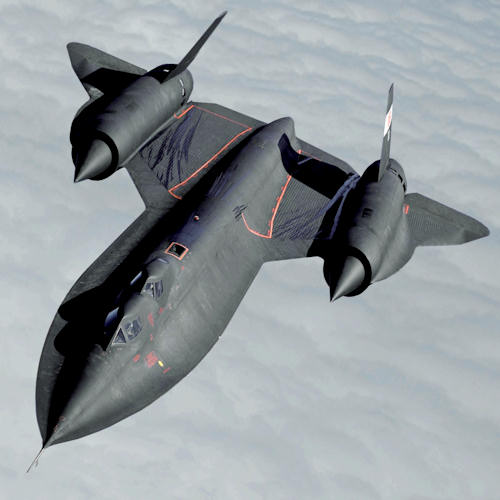
If we look at military jets, the king of speed is the American spy plane Lockheed SR-71 Blackbird. It operated with a top speed of over Mach 3.2 – which roughly equals more than 3,500 km/h (approx. 2,175 mph) up in the air. It is built in titanium and designed to withstand the extreme friction heat of over 300°C (572°F) at constant supersonic speed. The Blackbird aircraft has actually completed the exact same trip from New York to London of approximately 5,570 kilometers (approx. 3,460 miles) and set the undisputed world record. On September 1, 1974, an SR-71 Blackbird crossed the Atlantic Ocean in an insane 1 hour, 54 minutes, and 56 seconds – and that even included one mid-air refueling from a custom-built tanker aircraft (KC-135Q).
The development of jet engines is the reason this is possible. A jet engine works by sucking massive amounts of air in through the front. Inside the engine, there is a series of rotating blades that mash and compress the air extremely tightly. When the air is squeezed completely tight, jet fuel is injected and ignited. This creates a constant, controlled explosion. The superheated gases expand lightning fast and have only one way to escape – namely through the nozzle at the back of the engine at insane speeds, which thereby pushes the aircraft forward in the air with pure thrust.
If we now imagine telling Columbus and the people around him at the end of the 15th century that in a few hundred years, one would be able to fly to America in a metal tube at supersonic speeds in under 3 hours – what then? What if we could have told people in the Middle Ages about color television, the internet, and smartphones? How could we explain to the Vikings and their successors right up to the end of the Middle Ages about electricity, combustion engines, stereo systems, photos, x-rays, ultrasound and CT scans, and not least giant airplanes that can carry 400-500 passengers and bring them to distant lands within hours? All of which are things we all consider to be completely normal everyday items, simply created by technological development.
I think it is safe to assume that you would have been written off if you had claimed or even suggested such things in the Middle Ages or earlier. Perhaps you would have ended up on the bonfire for witchcraft, or you would have had your tongue cut out, been keelauled, or beheaded for madness.
Our frame of reference as human beings is always tied to the time we live in. We are not wired to be able to imagine something that must be considered highly unlikely in our contemporary age.
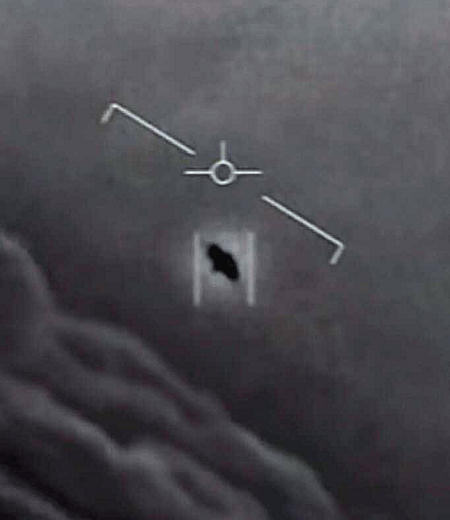
We actually do not even need to trace the threads back to the Middle Ages to see this mechanism in practice. If we just go back ten to fifteen years, you were quickly considered a bit crazy if you tried to talk seriously about unidentified phenomena or unidentified flying objects (UFOs). Today, the reality is entirely different. The Pentagon has established an official department called AARO to monitor and analyze the objects, NASA has set up their own research panels, and top universities like Harvard are running independent projects to understand what is today formally designated as UAP – Unidentified Aerial Phenomena or Unidentified Anomalous Phenomena. What was taboo yesterday has today moved right onto the serious scientific floors.
Limitless technological development
Despite our inherent reluctance to think outside our own timeframe, I will nevertheless attempt to do exactly that now. Keep in mind that the frame of reference from Columbus to today is merely about 500 years. At the same time, everything indicates that technological development is constantly accelerating, because we are getting more and more machines to work for us. This development might even be close to exponential now that we have also put artificial intelligence to work for us. So the question is what technological development will look like far into the future. One thing is absolutely certain, it will not be the status quo – it will instead be wildly insane. And if we look further into the future than just 500 years, what the development could bring seems limitless.
With this, we now begin these reflections by imagining a technological development that is so extremely far ahead of us that we can neither understand nor imagine it – exactly as the Vikings and Columbus would not have been able to understand our present-day technology. We are therefore moving from fact to pure science fiction, where it is no longer our development, but the technological achievements of an extraterrestrial (Extra Terrestrial) race that we must dive into, and then ponder what consequences and significance it might have for us humans here on Earth.
Quantum mechanics
Something that is heavily researched today is quantum physics. It is a branch of physics that describes matter and energy at the atomic and subatomic levels, where classical physical laws do not apply. The theories describe, among other things, how particles can exist in multiple states simultaneously (superposition), act as waves, and how energy is quantized into small packets.
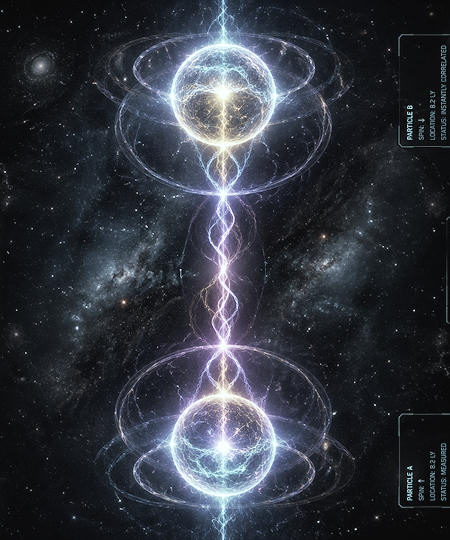
In another phenomenon called quantum entanglement, which we actually know exists in reality, two particles are turned into “twins”, after which they are linked in a way that defies all common sense. If you have one particle in London and the other in New York, and you give the one in London a “flick” so it starts spinning clockwise, the particle in New York starts spinning counterclockwise – in the exact same split second, and it happens faster than the speed of light. There is no signal that needs to be sent between them. No radio waves, no light. They simply react as if they were the same object, even though there are thousands of kilometers between them.
Einstein hated it and described it as ghostly distant action, because it seems completely impossible that information can move without a travel time. He called it “spooky action at a distance”, because it feels like magic. But today we know that it is real. We just cannot control it in large quantities yet.
Entanglement
Now we must imagine a foreign alien civilization somewhere else in the universe, which is many thousands of years ahead of us in development – perhaps even 100,000 years further ahead than us. We imagine that they have long since cracked the code to fully exploit quantum mechanics for their technology. It would be overwhelming to get into all the conceivable possibilities with this, so we will simply focus on the aforementioned quantum entanglement. Let us assume that they have found a way to pair the particles solely by coordinates. And then create a “wormhole” between them, so they can freely and instantly “travel” from point A to point B.
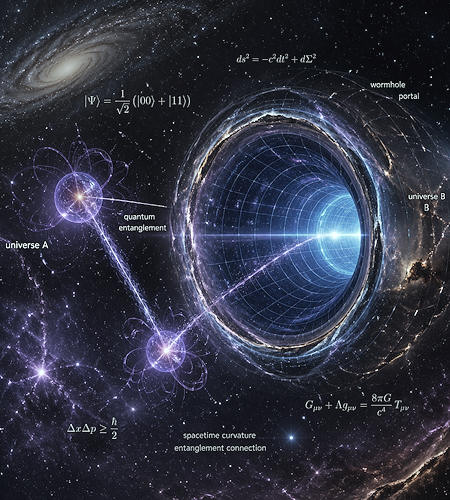
It could play out something like this: They have long since mapped the entire universe – or at least the part of it they reside in. You can imagine it as a gigantic network where every single millimeter has its very own unique coordinate. The principle is actually similar to our own GPS system, which precisely calculates an exact position in a three-dimensional space. The only difference is that their system is not limited to a single planet, but is stretched across the cosmos itself. An advanced civilization, therefore, does not look at the distance between Earth and a distant planet as a long road to be traveled. They quite simply view it as two specific coordinates on a map that has already been drawn.
Although the space between the stars seems incredibly empty, purely scientifically speaking, there is no such thing as an absolute vacuum. Even in the deepest darkness, the universe is permeated by radiation, dark matter, and invisible elementary particles. No matter where you point in the universe, there will therefore always be some form of elementary energy or particles present at the exact coordinates you wish to reach.
The secret lies in being able to reach out and grab those particles without moving. We imagine here that their technology can force an entanglement. By knowing the exact coordinates for the destination, the technology can lock the particles at the starting point, point A, to the particles at the target, point B, in a split second. The moment the entanglement is established, the distance in principle ceases to exist. The two points in the universe begin to behave as one and the same place.
This is where the physical journey becomes possible. When the entanglement is created, a kind of tear in reality emerges – a wormhole or a portal. It is like creating a doorstep in the middle of the void. They step into one side and are instantly standing on the other side. It is an elegant detour around time and space, where they have never been in motion in the traditional sense.
One might then think that such a thing must require enormous amounts of energy, but here we can imagine that they figured out a long time ago how to “tune” and harness the forces of nature that already exist in the universe. Whether it is magnetism, gravity, or a completely third force we do not yet have a name for, they are used as the propellant for their technology and their tools to keep the wormhole open.
The vinyl record analogy
To make this complex process tangible, you can use the imagery of an old LP record. We humans live our lives like the stylus needle riding down in the groove. We start at the first song and must politely wait for the record to spin around until we reach the last song. We feel every single millimeter of the groove, and it takes us the time it simply takes. This is our linear reality. We cannot just skip ahead, unless we have an engine that can drive extremely fast in the groove. When we talk about launching powerful space rockets out through the atmosphere, it is also the linear groove that is our only option. And when we use the enormous distances in the universe as an argument that a foreign civilization would never be able to reach us, it is also our perception of linear time in the “travel-groove” that is at play.
But an advanced alien civilization that is 100,000 years ahead of us with a technology that masters coordinates and entanglement of the universe, and who has learned to lift the tonearm, they see the whole record at once and know that the last song is physically only centimeters from the first, if you can just lift yourself free of the groove. By using the coordinates, they can move the needle directly across all the other songs and drop it down exactly where they want to be. They do not fly smoothly from A to B. They pop in and out of our reality because they are merely updating their coordinate on the universe’s great 3D map. And if we take it a step further, they also know all about scratching and sampling the record. This explains not just the “journey”, but also the strange visual observations of UFO phenomena – namely that they pop in and out of sight.
The linear illusion
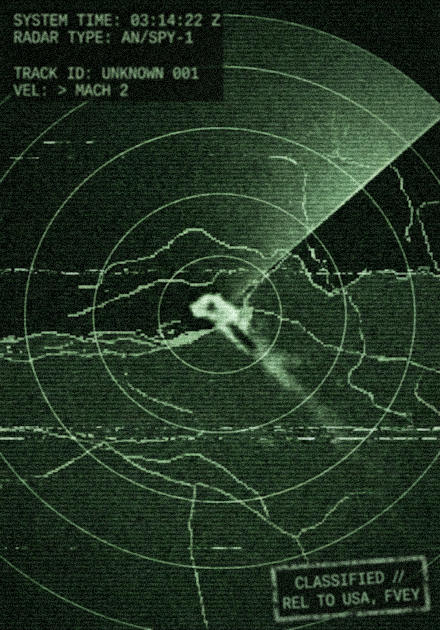
But the picture is more nuanced than that. When we look at the declassified radar recordings and videos from the military, where fighter pilots clearly track unidentified objects, they do not just pop in and out of sight. They are very much also flying linearly through our atmosphere. They can be followed on a route where they hover, stop, and suddenly accelerate. How does that align with a technology that navigates via entangled coordinates?
Here you can imagine the same effect as a mouse cursor on a computer screen. To us, it looks like a smooth, unbroken movement when we drag the arrow across the screen. But in reality, the computer is just updating the cursor’s position at intervals of a few milliseconds. If these objects are capable of updating their spacetime coordinates thousands of times a second over very short distances, it will look like a completely classic, linear flight to our radars and eyes.
This would at the same time provide a logical explanation for one of the military’s truly great mysteries: How it is possible to make abrupt 90-degree turns at hypersonic speeds without the interior getting crushed by G-forces. They likely never break the sound barrier or massively push against the atmospheric air – they might just be updating their exact position in space so incredibly fast and in such microscopic stages that they are practically never in motion in the traditional sense.
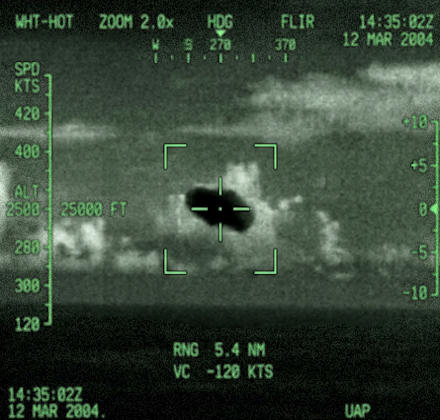
This principle likely interacts with some form of local propulsion when they are down in our sphere. Modern theoretical physics is already working today with the idea of being able to bend spacetime locally around an object, so that in practice it moves forward in its own shielded bubble. This would allow them to punch through both air and oceans without any noteworthy friction. The combination of high-frequency coordinate updates and a local manipulation of spacetime suddenly gives us a unified framework where even the most incredible radar tracks begin to make theoretical sense.
Demystification
It is essential to keep things separate when we are trying to understand a technology that is thousands of years ahead of our own. Even though it can be tempting to mix everything else into the equation, it often just muddies the picture and creates paradoxical challenges that are not at all necessary to explain the phenomenon.
If we stick to the idea of entangling the coordinates A and B, and combine that with the ability to perform lightning-fast, local position updates in our atmosphere, we are left with a model that is both cleaner and more logical in its simplicity than all sorts of imaginative theories about time travel, other dimensions, gods, Christ-figures, angels, demons, and ghosts – and what have you.
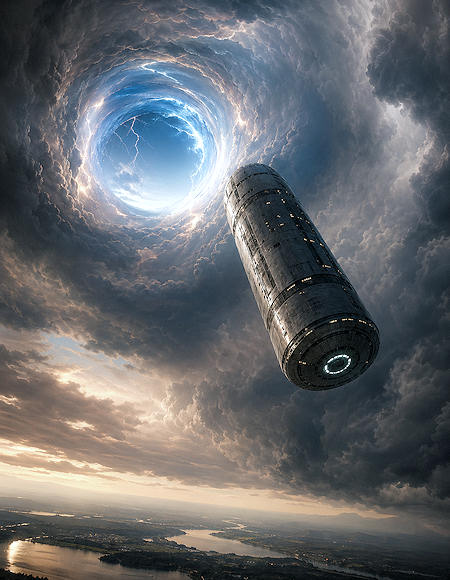
For us humans, the universe is characterized by enormous distances, because we are forced to move linearly through every single meter. But for a civilization that utilizes entangled coordinates, there is no “trip” between two points. There is only an arrival. This explains a permanent presence far more effectively than any theory about time travel.
If you can connect two points instantaneously, it means that you can be located on a coordinate right next to us, without us even noticing it, simply by making use of the forces of nature that lie beyond our current understanding.
This makes their presence far more tangible and less mystical. They are not here because they have traveled through millennia to find us, but because they have quite simply chosen our coordinate as a permanent address on their map. When the distance to their place of origin is made irrelevant in this way, they can operate physically in our sphere, while their starting point is in reality located 100,000 light-years away. They do not need to embark on endless, grueling expeditions, for when the universe can be folded together in a coordinate jump, they are always “at home” – regardless of where they are.
Why are they here?
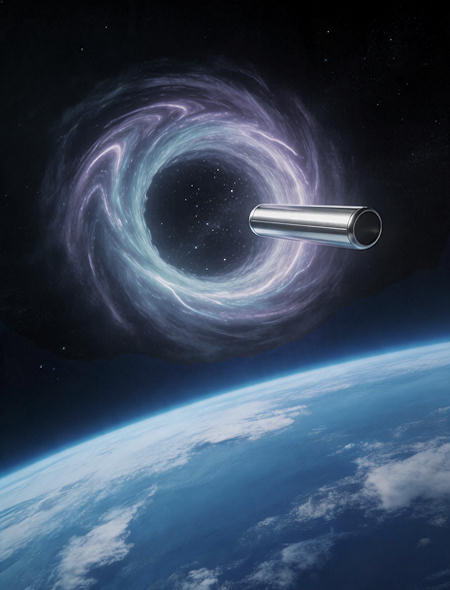
When we have taken the magic out of the equation and accepted that we are dealing with physical machines and a cold, hard navigation in the universe, the next big question arises: Why are they here? What is the motive for positioning themselves at our exact coordinates and remaining here?
We humans have a tendency to project our own colonial history onto the stars. We might imagine that a foreign power is coming to steal our water, our gold, or our minerals. But that is an incredibly narrow-minded way of thinking. If you master space and can arrive anywhere instantaneously, you suffer absolutely no shortage of material raw resources. There are endless amounts of frozen water on comets, and the cosmos is overflowing with lifeless asteroids packed with gold, platinum, and rare metals. But for a civilization that is a hundred thousand years ahead of us and has cracked quantum mechanics, even extracting minerals is presumably a completely outdated and primitive line of thought. When you can manipulate reality at a subatomic level, you can in all likelihood just assemble the atoms and elements you need from scratch. Why would they bother with Earth’s heavy gravity, a complex atmosphere, and us humans to fetch resources they can build themselves atom by atom in perfect peace and quiet? Using Earth as a mine quite simply makes no sense.
In reality, there is only one thing on this planet that is incredibly rare, and which the universe is not just overflowing with on the barren, lifeless rocks out in the dark. That is life and the complex biology attached to it. Earth is the result of billions of years of uninterrupted, chaotic evolution. Every single plant, every single insect, and every single piece of DNA is an extremely valuable snippet of code that cannot just be produced artificially in a lab.

Because when we talk about biology and DNA, we are not just talking about simple chemistry. We are talking about nature’s very own infinitely complex software. Even if an advanced civilization can build elements atom by atom, they cannot just calculate their way to the survival strategies that are coded in our biology. This is where we find the very recipe for instincts and urges – and regardless of how one precisely understands consciousness, it is undoubtedly tied to this unfathomably advanced biological interaction. Our cells work together in a microscopic network of indescribable precision to create and maintain life. It is information created exclusively by time and endless adaptation.
Viewed in that perspective, Earth is not a stockpile of raw materials. It is a unique, irreplaceable, intergalactic eco-library. A kind of biological greenhouse in the middle of an otherwise incredibly cold and radiation-filled space.
When we start seeing our planet as a biological library rather than a gravel pit, their observing behavior suddenly makes a lot more sense. If they are here to monitor and protect the library itself, then we humans are just another animal species on the shelf. This explains the ice-cold and detached way they operate. They do not land on the lawn in front of the White House, because they are not saviors who have come to save humanity from ourselves. They function to a far greater extent as a sort of cosmic gardeners. A gardener does not interfere in whether two ants are fighting down in the lawn, or which of them wins the battle. The ants are allowed to live their own lives and fight their own territorial battles. But the moment the ants invent matches and threaten to burn the whole greenhouse down, the gardener promptly steps in.
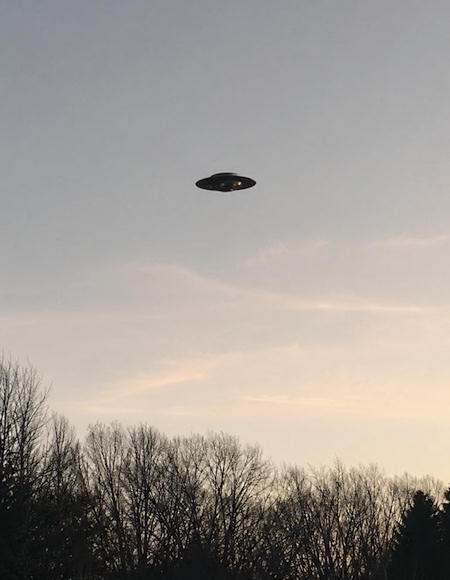
That leads us to a series of observations that have surfaced over the decades in the most closed-off military circles, and which are often highlighted as one of the most significant signs of their presence. Here we are talking about accounts from former officers and technical personnel at nuclear weapons bases – both in the US and the former Soviet Union – where unidentified objects have been seen hovering right over the nuclear missile silos. What is remarkable about these descriptions is not just the sight of the crafts, but the repeated reports that state-of-the-art nuclear missile systems have been deactivated without explanation during the exact minutes the objects were present. These are incidents that have been described under oath by former employees who were responsible for these very weapons, and it leaves us with a rather profound question: Why this interest in our nuclear weapons?
If we try to connect these incidents to our theory about the biological library, a pattern emerges that seems far more probable than just random technical glitches. You can imagine that these interventions act as a kind of ultimate emergency brake. It could suggest that they are not necessarily shutting down the systems to save humanity or ensure world peace as an act of mercy, but rather because nuclear weapons pose a threat to the biological foundation of the planet itself.

The moment we reach for the matches that can burn down the entire greenhouse, we see these signs of intervention. This shifts the perspective from being about our political conflicts to being about an overarching interest in preserving the complex biology that Earth represents. This makes their actions much more logical and perhaps even chilling: They are possibly not looking out for us, but for the irreplaceable DNA archive that we ourselves are a part of, and which we share the planet with.
We are allowed to wage our political wars and live our lives, exactly as we usually do – right up until the day we threaten the planet’s very ability to sustain life. To them, we are not the owners of Earth. We are just an incredibly noisy and potentially dangerous species that has right now learned to build the weapons capable of destroying the greenhouse along with the entire biological library.
Next article: When technology fails
We have now made a plausible case for a theoretical foundation of how a foreign intelligence could potentially navigate, and we have formulated an educated guess as to why they would even be here in the first place. But if we accept the premise that we are dealing with regular physical objects rather than magic, we inevitably run into what is perhaps the most frequently asked question from skeptics: If they are a hundred thousand years ahead of us technologically, how on earth is it even possible that they crash every now and then?
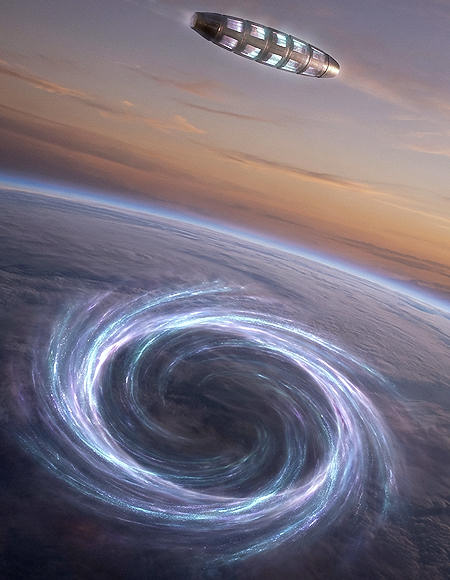
A possible explanation could lie exactly in the way we imagine they navigate. If you move by updating your coordinates across the infinite structures of the universe, it presumably only takes one unimaginably small calculation error in the system before things go fatally wrong. Then they risk materializing directly into a cliff wall or slamming into the surface of the earth with massive force. Any kind of technology can fail sooner or later – a fact we know all too well ourselves, and we will take a closer look at that in the next article. Because if an unidentified object crashes, someone is also likely rushing out in deepest secrecy to pick it up.
In the next article, we will therefore also look closer at the theories concerning the hidden recovery operations and the absurd race to understand the technology through “reverse-engineering” – meaning the attempt to pick the objects apart and copy the technology without having the manual. We will examine the fierce military cover-up and look at why the truth might not lie on a desk at the Pentagon at all, but rather is perhaps hidden deep down in the basement of private defense contractors, where it is totally shielded from the freedom of information requests of politicians and public scrutiny.
Furthermore, we will also look at the ultimate price for keeping a secret of this caliber hidden for decades. From the extreme non-disclosure agreements to the eerie and highly current trend, where the line of top scientists and insiders who suddenly vanish without a trace or die under mysterious circumstances keeps growing longer and longer.
We will dive into the cover-up in the next part… that is, if and assuming I am not silenced beforehand, suddenly disappear into thin air, or simply die under unexpected circumstances!
Until next time – keep seeking the logic in the light.
A quick note on support: I do not have a large, established network behind me, which means my social media channels are very quiet right now. If you found value in this article and appreciate the completely free format with no ads, the easiest way to support the project is to leave a like or a follow on my channels in the footer below. It breaks the silence and helps breathe a little life into these community platforms, which makes a real difference. Thank you!