
The Illusion of Infinity: A Theory of Discontinuity and the Absolute Reset
By Brian Poulsen | January 2026
Introduction: The Mathematical Deception
Throughout human history, the concept of “infinity” has fascinated philosophers, theologians, and mathematicians alike. We have learned to accept infinity as a real quantity – that time stretches eternally backward and forward, and that the universe is an infinite stage.
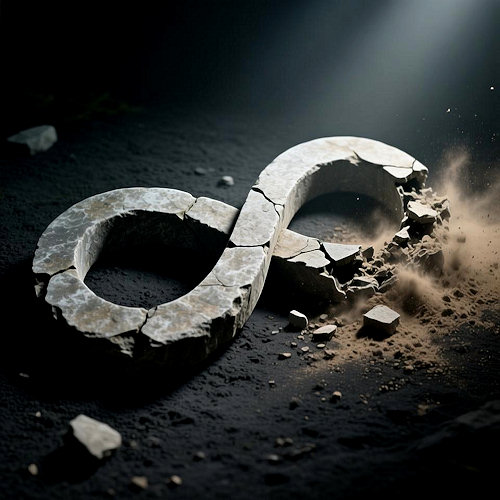
My thesis, however, is that the phenomenon of infinity is an illusion. It is a mathematical tool that we have erroneously projected onto physical reality. In the real world, nothing can be infinite.
This article will argue that existence is conditional upon observation (that someone or something registers it), that “nothingness” is unstable, and that the universe must necessarily undergo a total and absolute reset, whereby the concept of infinity loses its meaning.
1. The Conditions of Existence: Observation and Time
The foundation of this theory rests on a simple yet radical realization: Nothing can exist without observation. This should not be understood solipsistically – i.e., the idea that the world only exists inside my own head – but as a physical necessity. Without interaction, without an observer or a receiver of information, concepts like “time” and “space” cease to make sense.
Time cannot be infinite, for time is a measurement of change. If the universe reaches a state where nothing changes and no one observes it, time stands still. Time is thus not an independent river flowing eternally; it is a property of matter and the observer. Without them, time stops. Therefore, “infinite time” is a physical impossibility.
2. Confronting Eternal Matter
A classic counterargument is that matter persists regardless of whether we look at it or not – that “the rock is a rock,” even without an observer. However, this argument fails when viewed from a cosmological perspective.
All physical matter is subject to entropy – nature’s tendency towards disorder and decay. Just as the rock did not exist before its atoms were gathered, it will not exist when its atoms are scattered again. The rock has a start and an end. The same applies to the universe. If the universe, as modern cosmology suggests, started with the Big Bang, it has a birth date. Something with a start cannot, by definition, be infinite backwards in time.
But what about the future? The Standard Model of physics predicts a “Heat Death,” where the universe ends as a cold soup of subatomic particles floating in darkness forever. Here, my theory differs markedly from the established consensus.
3. The Functional Cessation of Matter
The Standard Model errs when it assumes that particles (electrons, protons, photons) can exist forever in an empty universe.
My hypothesis is that existence is tied to function and influence. When matter no longer serves a purpose, when it no longer interacts with anything else, and when the universe has expanded to the point where causality – cause and effect – breaks down, matter loses its right to exist.
We must assume that nature cleans up after itself. Where modern physics (Grand Unified Theories) speculates that matter decays slowly over enormous timeframes (so-called proton decay), my theory takes the full step: All matter will, after Heat Death, dissolve completely. It will return to the state it came from. The universe will not end as a graveyard of dead particles, but as absolute nothingness.
4. The Creation: The Error in Nothingness
If we accept that everything must resolve into absolute zero – no time, no space, no energy – we are faced with the question: How can something arise again?
I am not a physicist, and I do not claim to know the complex mathematical equations behind the Big Bang. My approach is logical and philosophical, based on observations of nature’s patterns. Yet, when diving into modern theories, one finds that physics actually supports the logic I present here.
Here it is important to distinguish: I am not talking about a “physical vacuum” (an empty space), for even empty space is “something.” I am talking about the absence of space itself and the laws of nature.

The answer lies in nature’s fundamental fallibility. This thought has been with me since I was a child. I remember clearly how we children would lie on our stomachs in the grass looking for four-leaf clovers. We looked at a whole lawn full of three-leaf clovers – the normal, the perfect, the static – but it was the “error,” the four-leaf clover, we were looking for. Later in life, I reflected on how genetic “errors” like Down syndrome arise as variations in chromosomes. Nature fails constantly. And precisely this fallibility is the key to existence itself.
The creation of the universe – the Big Bang – was not a perfect, divine plan, but a cosmic “four-leaf clover.” An “error” in nothingness. A symmetry breaking.
“Absolute nothingness” is an unstable state. According to quantum mechanics, a value of exactly “0” cannot be maintained eternally. One can illustrate this by imagining that zero never stands completely still; it stands “jittering” and oscillating constantly a little bit towards +1 and a little bit towards -1. It seeks a balance it cannot hold. Nothingness will therefore inevitably fluctuate, make an error, and create something out of nothing.
One can view perfect “nothingness” as a smooth surface. As the instability occurs, a break happens. The energy for this break does not come from outside, but from a division of the zero.
The hypothesis of a “Zero Energy Universe” supports this: The total energy of the universe is zero. The positive energy (matter and light) is exactly balanced by the negative energy (gravity). Therefore, creation is “free.” The universe is an account created by splitting nothing into two parts: plus and minus. An error in the zero line.
But how does this tiny, microscopic “error” become an entire universe filled with stars? It seems intuitively impossible to get “something” for “nothing.” Here, it is crucial to understand the mechanism behind creation: Separation.
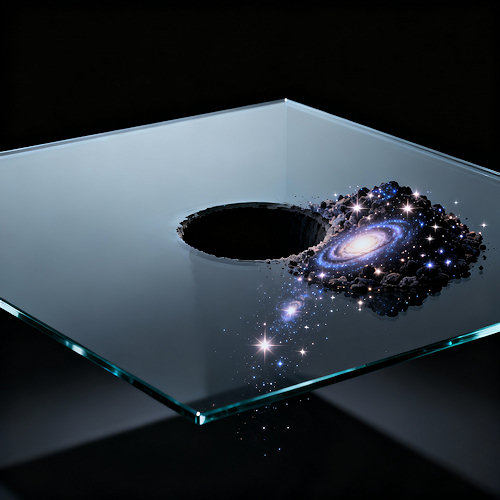
Imagine a completely flat lawn (Nothingness). If you want to build a hill (The Universe/Matter), you cannot get the soil from outside, because there is no “outside.” You have to dig a hole. When you dig the hole, you get a pile of soil.
• The pile is positive (The Hill/Matter).
• The hole is negative (The lack of soil).
If you put the pile back into the hole, you get the flat lawn again. The result is zero. But as long as the pile and the hole are kept separate, you have created “something.” (It is important to emphasize that this is merely a pedagogical image – in absolute zero, there is naturally no physical shovel or lawn, but the principle that one can create something by splitting a zero holds true).
This principle is known in physics as the ‘Zero Energy Universe‘ hypothesis and is described by, among others, Stephen Hawking and Alan Guth (the father of inflation theory): “The universe is the ultimate free lunch.”
In physics, the “pile” corresponds to all matter and energy in the universe. The “hole” corresponds to gravity (which is negative energy).
When the “error” (the instability) occurred, it did not create energy out of thin air. It tore “nothingness” in half. In one hand we got matter (+1), and in the other hand, we got gravity (-1). The enormous bang – the Big Bang – was not the “sound” of something arriving from outside, but the “sound” of “Nothing” being torn apart into two opposing poles. Therefore, creation does not require infinite energy; it requires only a separation. We live, so to speak, on a loan, and the existence of the universe is merely the period where the pile lies beside the hole, before it inevitably falls back.
5. The Cyclical Illusion
When the current universe has exhausted its energy, and matter has dissolved due to a lack of functional observance, we return to the unstable zero. From here, the process will repeat itself. A new instability will create a new Big Bang.
Is this, then, not infinity? No.
Here, my theory differs from physicist Roger Penrose’s “Conformal Cyclic Cosmology” (CCC) model. Penrose looks for “scars” or information that survives from one universe to the next. My theory dictates a total reset. Because all matter and all structure dissolve, all information is deleted. There is no memory. No “God” or law of nature hovering outside remembering the previous universe.
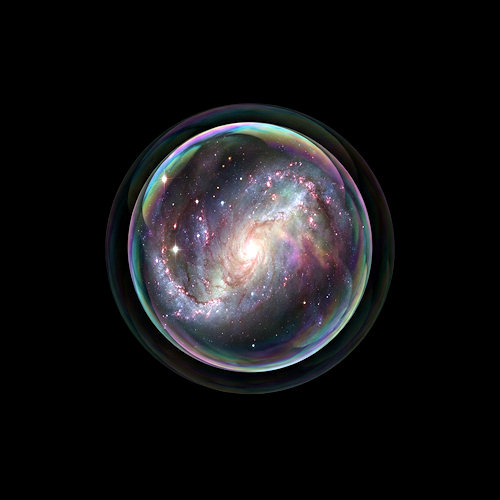
Each universe is an isolated island of time, surrounded by nothingness. There is no connection between Universe A and Universe B. Universe B is not a continuation of A; it is a new, independent emergence.
Therefore, infinity does not exist. Only the “now” and the temporary cycle we are in exist.
6. The Final Full Stop
The purpose of this theory is not to describe the physics of the universe, but to draw the final logical consequence regarding the very concept of infinity.
Mathematics can operate with infinity because paper is patient. But reality is impatient. Reality requires observation and change to exist.
My conclusion is, therefore, that infinity cannot exist in reality because any attempt to “complete” infinity will be interrupted by nature’s own stop. Nothing can go on forever because time itself dies when matter dissolves. Even if the universe restarts in a new cycle, it is not an extension of the previous one, but a new beginning. Infinity requires continuity, but nature offers only discontinuity.
Thus, reality places a full stop where mathematics places an infinity symbol. We exist in a parenthesis between two nothingnesses, and it is precisely this limitation that makes existence possible – and valuable.
This theory is a philosophical synthesis based on my observations and theories developed over decades. It acknowledges and builds upon physical principles from, among others, Roger Penrose (cyclic time), Stephen Hawking (Zero Energy), and Heisenberg (quantum uncertainty), but draws a new and more radical conclusion that breaks with the established Standard Model: That infinity is an impossibility, and that the universe resets totally without the transfer of information.
All images are generated with AI.
This article is a translation of the original Danish version.
A quick note on support: I do not have a large, established network behind me, which means my social media channels are very quiet right now. If you found value in this article and appreciate the completely free format with no ads, the easiest way to support the project is to leave a like or a follow on my channels in the footer below. It breaks the silence and helps breathe a little life into these community platforms, which makes a real difference. Thank you!