

The Digital Treadmill: We Are Updating Ourselves to Death
By Brian Poulsen | January 2026

It really started with a simple desire for a website. just a basic WordPress blog where I could share my thoughts. I imagined the work would consist of writing posts and generate a few images.
I was wrong.
Today, I spend half my time as a “digital janitor.” Every time I log in, I am greeted by red circles and warnings. – A plugin needs updating. The theme is “outdated.” The PHP version is too old. The database needs optimizing.
What was supposed to be a creative sanctuary has become an endless list of chores.
And therefore it struck me recently: It’s not just my website. It’s our entire digital existence.
We have ended up in a global race where “new” has become synonymous with “necessary,” and where we, as users, have been reduced to involuntary beta-testers for an industry that has lost touch with reality in favor of a race against algorithms and shareholder expectations.
From Windows to Web hosting: Update Terror and “Enshittification”
The most stressful moment in a modern workday isn’t a tight deadline. It’s that little notification in the corner of the screen: “Restart to update.”
If you use Windows, you know the frustration. The updates come crashing in constantly. Sometimes it’s security (fair enough), but often it’s “features” nobody asked for. Suddenly, you have an AI assistant in your taskbar, or your start menu has been redesigned to show more ads.
There is a term for this, coined by author Cory Doctorow: Enshittification. It covers how digital platforms slowly become worse for users via updates, but better for the company’s bottom line. When Windows updates today, it’s rarely to make your PC faster. It’s to harvest more data or force you to use their services. Operating systems – whether Windows or macOS – are no longer stable platforms we work on. They are living marketplaces shifting beneath our feet.
The same applies to browsers. I’ve used both Firefox and the old Internet Explorer (now Edge) since the early-00s, and later jumped on the Chrome bandwagon. Across them all, I’ve seen the evolution go from “necessary maintenance” to “aggressive feature hunting.” For Firefox we are now up to version 147.0.1, and updates arrive so fast that quality assurance cannot possibly keep up. Version 147.0.1 isn’t a seal of quality; it’s a testament to a development cycle out of control. Every 3-4 weeks, new code is forced through to support the latest web APIs or AI integrations that no one asked for, but marketing departments demand.
In pure desperation, I have now set my browsers to update automatically in the background, simply because I couldn’t bear to be disturbed anymore. I have effectively handed over the keys to my digital front door, just to get some peace.
Apps: The Red Number as a Drug

On our phones, it’s even more cynical. Have you wondered why your apps need updating every fortnight, often with the meaningless text: “Bug fixes and improvements” ?
It’s rarely about bugs. It’s about visibility. The algorithms in the App Store and Google Play are rigged with a so-called “Recency Bias.” If an app developer doesn’t release an update for a few months, the app is punished and hidden away in search results. Therefore, developers are forced to invent updates. They change the color of a button or update a tracking library just to hit “Publish” and show the algorithm they are still alive.
It is a three-stage rocket of manipulation:
- “I’m still alive!” (Psychological Marketing)
For a plugin company or an app developer, an update is a free billboard. When you see that red number on your icon, you think of them. If a plugin hasn’t been updated in six months, people ask: “Is the project dead? Dare I use it?”. By fixing an irrelevant typo in a menu, they can stamp their plugin as “Updated today,” making it look fresh and safe. - Algorithm Grooming
On platforms like the App Store, software is ranked by how “current” it is. Frequent updates signal to the algorithm that the developer is active. It is SEO (Search Engine Optimization) disguised as software updates.
“Recency Bias” forces developers to invent updates just to signal “we are alive” to the algorithm. That’s why we see changelogs like: “Bug fixes and performance improvements” with no further info. It’s code for: “We haven’t done anything, but we want to stay on top.” - The Agile Method (The Development Rat Race)
Modern software development follows “Agile” principles, releasing things as soon as they are “done.” In the old days, updates were bundled into large packages every three months. Today, they release every time a programmer fixes a comma. It’s efficient for them, but it creates “Update Fatigue” for us users.
The Economics Behind It: The Subscription Trap
But why do they do it? The answer, as always, is money. We no longer own our software. We rent it. Software-as-a-Service (SaaS) means we pay monthly subscriptions for everything from the Office suite and Photoshop to specialized software like video upscaling. Where you once bought a lifetime license, you are now forced onto monthly payments. The same applies to the new AI services for chat, video, and image generation, where you often buy ‘credits’ that vanish at the end of the month if unused.
If Adobe, Microsoft, or your preferred AI service didn’t update constantly, customers would start asking: “Why am I paying an expensive subscription every month if the product is exactly the same as a year ago? ” Updates have become their only excuse to keep charging your card. They have to invent new features – even ones that make the product worse or more cluttered – to justify the subscription.
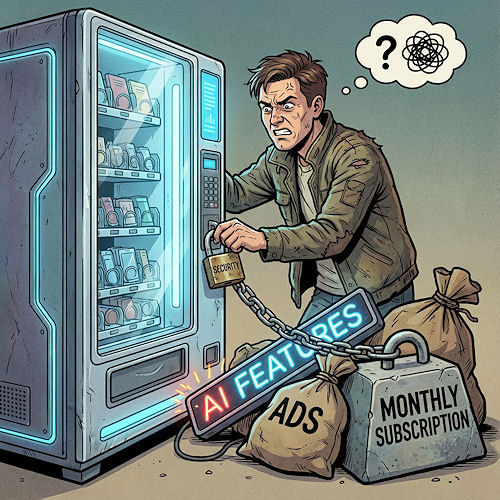
I see it myself right down in the WordPress engine room. Plugins like AIOSEO update constantly, and suddenly simple functions, like uploading a “person logo” for Google, are hidden away or wrapped in confusing menus screaming “BUY PRO VERSION.” They use updates to change the user interface so free features become harder to find, while payment buttons become larger. It’s not an update of functionality; it’s an update of sales tactics.
The Security Dilemma: We Are Held Hostage
The worst part of this situation is that we can’t just opt out. We are held hostage in a security dilemma.
Manufacturers have figured out how to “bundle” things. They mix critical security fixes, which we must have to avoid being hacked, together with heavy feature updates and ads that we don’t want. I want to lock my front door (security update), but the locksmith refuses to do it unless he is also allowed to paint my entire house neon pink and install a surveillance camera in the living room (feature bloat).
We cannot say “yes please” to security without also saying “yes please” to all the other junk. And that is precisely where the danger arises. Because when we accept everything blindly, we also accept the flaws.
The Hidden Consequences: Hardware Waste and ‘Terms of Service’
Before we look at the major crashes, there are two “invisible” costs to this race that we rarely discuss.
Firstly, there is the hardware paradox. It is, of course, fair that Microsoft cannot security update Windows 10 forever – development is necessary. But it creates a dilemma where fully functional hardware often has to be scrapped simply because it can no longer run the newest, heavy software. The hardware is fine, but the code has become too demanding. It’s the price of progress, though we can take some comfort in the fact that electronics recycling technology is improving.
Secondly, there is the legal sneak. When we click ‘Update’, we often accept new terms. Sometimes it’s positive, like GDPR legislation forcing companies to protect our data better. But in 2025/2026, we more often see the flip side: The update gives the company the right to use your data to train their AI. As we saw with Meta (Facebook) last year, a simple text about “Updated Terms” can effectively mean: “Now we are using your photos to make our robot smarter.”
When Haste Becomes Deadly: The Great Crashes
While on the phone it’s mostly just annoying, the consequences are fatal when we scale up to global infrastructure.
We got the ultimate scare in July 2024 with CrowdStrike. Here, it wasn’t a hacker taking down the world. It was a security update. A small file meant to protect computers was rolled out automatically to 8.5 million Windows machines worldwide. The result? Everything went black. Flights cancelled, operations postponed, and supermarkets unable to accept payments. Why did it go wrong? Because it had to go fast. The file wasn’t tested well enough before being sent out to everyone at once. It was a security update that did more damage than any hacker has ever managed. It was more dangerous than the threat it was meant to protect against.
You would think the industry learned something, but 2025 was the year that proved the opposite. We saw gigantic outages at both AWS (Amazon) and Cloudflare late in the year.
- Cloudflare (November 18, 2025): The major outage that took down large parts of the web. It was caused by an update to a “feature file” in their database cluster (ClickHouse). A routine database update toppled the dominoes, creating massive global authentication failures.
- AWS (October 20, 2025): The world’s largest outage in 2025. 17 million error reports. An internal update dragged Snapchat, streaming services, and countless businesses down with it. The point is terrifying: When even Amazon, who owns the infrastructure, cannot update without toppling the world, the system is too fragile.
Both are the backbone of the internet. And in both cases, the cause was internal updates and configuration changes gone wrong. We have built systems so complex that even the engineers who built them cannot predict what will happen when they press the “Update” button.
The Prophecy for the Future: It Gets Worse
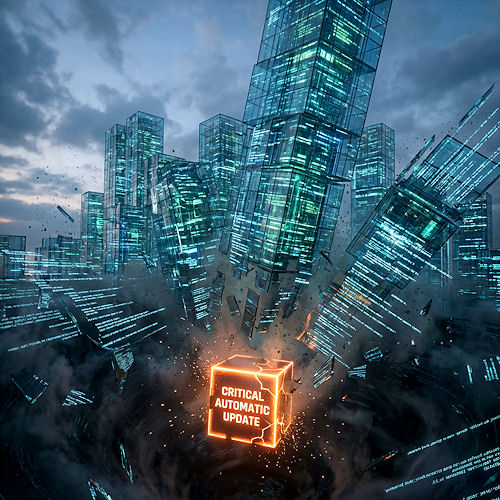
We are now at the start of 2026, and nothing suggests the pace is slowing down. On the contrary.
My fear – and my prediction – is that we haven’t seen the worst yet. We have made ourselves dependent on systems that update themselves automatically: From my WordPress website and your iPhone to the servers controlling power grids and banks. When you combine “automatic updates” with “lack of testing” and “financial incentive for constant change,” you are asking for a disaster. In 2025, we saw the cracks in the foundation.
We call it “Agile.” We call it “Progress.” But in reality, it is digital Russian roulette, and the chamber is getting full. In the future, we risk the house collapsing in a Supply Chain Attack, where a single, small, automatic update spreads like poison through the entire system.
Perhaps it is time we reclaim the right to say “no thanks.” That we dare not to update that plugin, that app, or that operating system if it works fine today—even if it requires courage to ignore the red warnings. Because right now, it feels like we are all sitting in a race car doing 120 mph, where the mechanic insists on changing the wheels while we drive. The new tires might be smart, but the risk of crashing is simply becoming too great.
NB: Important Note to the Reader
The purpose of this article is to focus on the uncritical “update culture” driven by marketing and algorithms. However, it is important to emphasize that I am not encouraging ignoring critical security updates. It is a difficult balance, but the point is that many updates today are not about your security at all, but about someone else’s bottom line.
All images are generated with AI.
A quick note on support: I do not have a large, established network behind me, which means my social media channels are very quiet right now. If you found value in this article and appreciate the completely free format with no ads, the easiest way to support the project is to leave a like or a follow on my channels in the footer below. It breaks the silence and helps breathe a little life into these community platforms, which makes a real difference. Thank you!